

Craps Strategy
Good craps strategy is not about predicting dice. It is about choosing bets with favorable math, sizing them responsibly, and avoiding the parts of the layout designed to tempt impatient players. Before using any system, make sure you understand the rules of a round, the full list of craps bets, and the terms dealers use from the glossary.
Why Strategy Matters in Craps
Every casino game has a house edge, but craps lets players choose between low-edge wagers and expensive high-volatility wagers on the same table. That choice matters. A player grinding Pass Line with odds is playing a very different game from someone firing Any Seven, horn bets, and hardways every roll. Strategy cannot remove randomness, but it can lower the expected cost of play and make your bankroll last longer.
The best strategies are boring in the right way. They repeat strong decisions, control bet size, and let short-term luck decide only the current session rather than your whole bankroll. If a system asks you to chase losses with bigger and bigger bets, treat it carefully. Craps has no memory, and the dice do not owe the table a correction.
The Golden Rule: Always Take Full Odds
Free odds are the defining advantage of craps. Once you have a Pass Line or Come point, an odds bet pays at true odds. On 4 and 10 it pays 2 to 1, on 5 and 9 it pays 3 to 2, and on 6 and 8 it pays 6 to 5. Because the casino takes no edge on the odds portion, taking odds lowers the blended edge of your overall action.
The word full depends on the table. Some casinos offer single odds, double odds, 3-4-5x odds, 10x odds, or even higher. You do not have to take the maximum if it makes your session too volatile. The strategic point is that odds are where additional craps money is best placed after your required flat bet.
A practical compromise is to take odds at a level you can repeat comfortably through several shooters. Full odds are mathematically attractive, but a nervous player who overbets may abandon the plan after one seven-out. Sustainable sizing matters as much as theoretical value.
Best Bets for Beginners
| Plan | Core Bets | Why It Works |
|---|---|---|
| Simple right-side | Pass Line + odds | Easy to follow, low house edge, social with the table. |
| Expanded right-side | Pass Line, Come, odds | Covers multiple numbers while keeping strong math. |
| Dark-side conservative | Don't Pass + lay odds | Low edge and benefits from the frequency of seven. |
| Place-number focus | Place 6 and 8 | Simple dealer-placed bets with reasonable house edge. |
Worst Bets to Avoid
Be careful with the center of the table. Proposition bets, Big 6/8, many horn combinations, and Any Seven can drain a bankroll quickly. They are not forbidden, but they should be treated as occasional entertainment.
Popular Craps Systems
The 3-Point Molly
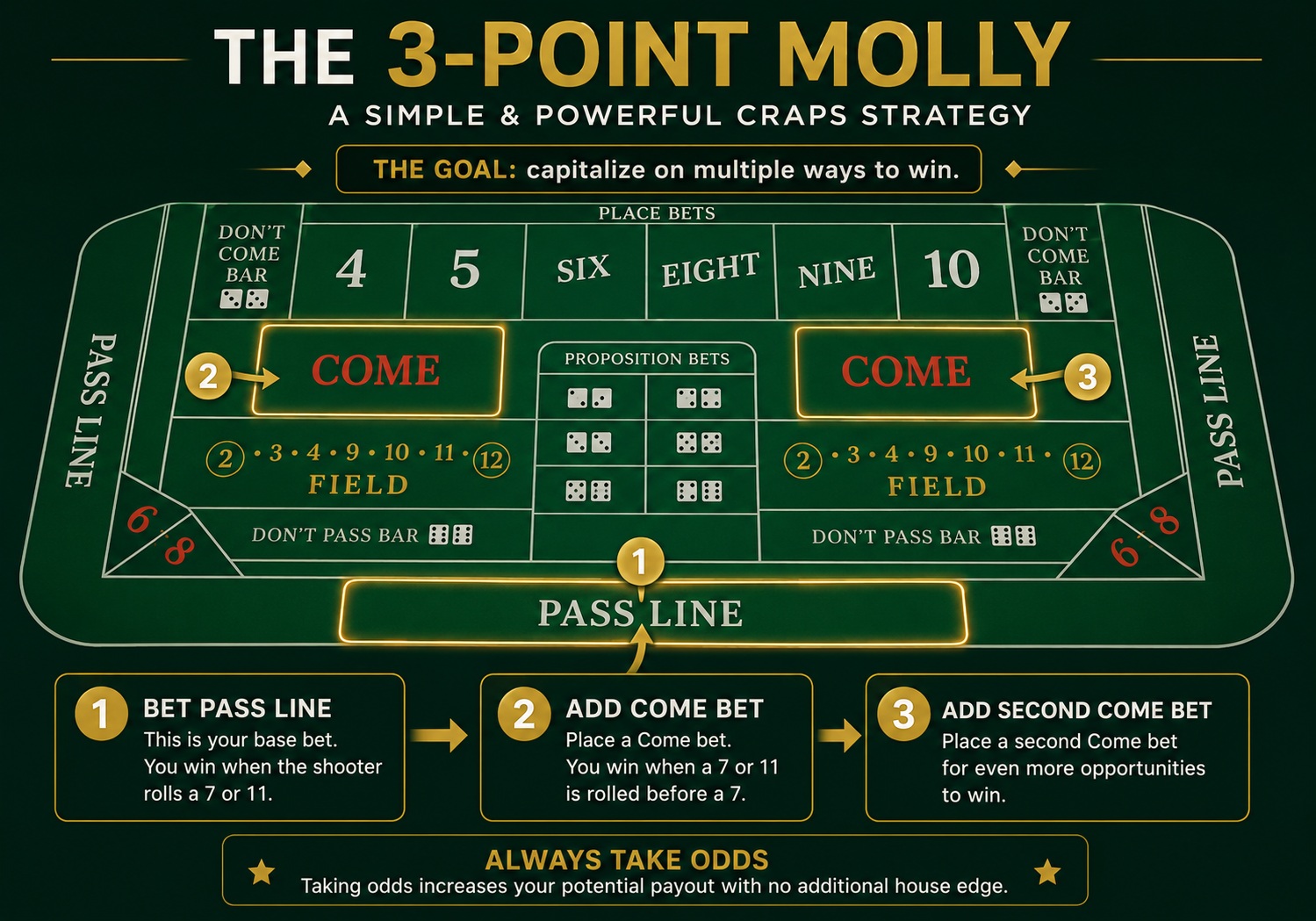
The 3-Point Molly is a disciplined right-side system. You begin with a Pass Line bet. If a point is established, you add odds behind the Pass Line. Then you make a Come bet. If the Come bet travels to a number, you add odds there too. You repeat until you have three numbers working: the original Pass Line point plus two Come points.
The system keeps you on strong bets and prevents you from covering the whole table impulsively. Its downside is exposure. When a seven-out arrives, multiple working bets can lose together. That is why bankroll sizing matters. Many players use smaller flat bets and conservative odds so the system has room to breathe.
Iron Cross
The Iron Cross places the 5, 6, and 8 while also betting the Field. The idea is to win something on every number except 7. It feels active, but it combines decent place bets with a Field bet that can be mediocre depending on table rules. Use it as a short-term action system, not a mathematical miracle.
Press and Regress
Press and regress players increase bets after hits, then reduce them after collecting a target amount. This can turn a hot shooter into meaningful profit while pulling money off the layout before variance turns. The weakness is timing: no system knows when a roll is about to end.
For example, a player might place the 6 and 8, press each first hit, then regress both numbers after collecting two wins. The goal is not to beat the math; it is to create a clear rule for locking profit and avoiding emotional decisions during a hot roll.
Don't Pass Dark Side Strategy
Dark-side strategy uses Don't Pass, Don't Come, and lay odds. It has strong math but a different social feel because you win when the shooter fails. Quiet, courteous play matters here. Do not celebrate seven-outs at a crowded right-side table.

Bankroll Management
Set a session bankroll before you buy in and divide it into units. A $300 session with $10 units gives you room for flat bets, odds, and normal variance. A $300 session with $50 units can disappear in one cold hand. Use stop-loss and win goals, and decide them before the table gets emotional.
A practical beginner rule is to risk no more than 5% of the session bankroll on the layout at one time until you understand your volatility. If you play online, practice in free mode first and then move to real-money tables only when the bet flow feels automatic.
Volatility vs. House Edge
A low house edge does not guarantee a smooth session. Odds have no house edge, but they increase the amount at risk and can make swings larger. Proposition bets have high house edges and high volatility. Good strategy balances mathematical value with emotional comfort.
Think of house edge as the price of the bet and volatility as the size of the ride. A small Pass Line bet with single odds has a low price and moderate swings. A table-max odds bet has a very low blended edge, but the dollar swings are much larger. A horn-heavy session has both high price and high volatility, which is why it can feel thrilling and punishing at the same time.
The strongest strategy is the one you can execute calmly. Choose bets before emotion rises, decide how you will press or regress, and leave the table when your stop point arrives. If you want to experiment with systems, test them in free online craps first so the mechanics become automatic.
Sample Low-Risk Session
For a $300 bankroll at a $10 table, you might start with $10 on the Pass Line and $20 odds after a point. If the point is 6 or 8 and you want more action, add a $12 Place 6 or Place 8 only when it does not duplicate the point. Collect the first win, then decide whether to press by one unit or keep the money. This is not a guarantee, but it is organized, understandable, and mathematically respectable.
Practice for Free Online
Use online craps to practice bet placement, odds timing, and bankroll discipline before playing for higher stakes.
Learn About Online Craps