

The History of Craps
Craps feels modern because of its casino layout, dealer crew, and shouting rail, but dice gambling is far older than the Las Vegas strip. The game carries traces of ancient chance rituals, medieval European gaming, New Orleans street culture, riverboat gambling, military barracks, and online casino technology. Understanding that lineage makes the table feel less like a puzzle and more like a living tradition.
Ancient Origins of Dice Games

People have thrown marked bones, stones, and carved cubes for thousands of years. Archaeologists have found dice-like objects in ancient Mesopotamia, Egypt, Greece, Rome, India, and China. Some were used for games, some for divination, and some for gambling. Roman soldiers were especially associated with dice play, carrying simple gaming pieces that could be used wherever an army camped.
Those early games did not look like modern craps, but they established the enduring appeal of dice: quick results, visible randomness, and the drama of everyone watching the same throw. Dice are tactile and public. Once they leave the hand, the outcome belongs to the table.
That public quality separates dice from many private games of chance. A card can be hidden. A wheel can feel distant. Dice travel through the air in front of everyone, bounce against the rail, and settle in plain view. Craps inherited that theatrical moment from a very old human fascination with chance.
Hazard: The Medieval Ancestor
The clearest ancestor of craps is Hazard, an English dice game popular in the medieval period. Hazard used a main number and chance numbers, with players betting around combinations and repeated throws. The rules were more complex than modern craps, but the central idea of establishing a number and then rolling against it survived.
The word craps is often linked to the old term crabs, referring to losing throws such as 2 or 3. Literary references to Hazard, including mentions around the age of Geoffrey Chaucer, show that dice games were familiar across classes. They appeared in taverns, courts, military settings, and informal gatherings where money and reputation could change hands quickly.
From Hazard to Craps: The French Connection
French influence helped carry Hazard-style games into Louisiana. New Orleans became an important point of transformation because it blended French, Spanish, Caribbean, and American gambling cultures. Bernard Xavier Philippe de Marigny de Mandeville is often associated with popularizing a simplified version of Hazard in the area, though the game evolved through many hands rather than one inventor.
The simplified street version was easier to learn, faster to deal, and well suited to informal play. That made it portable. Players did not need a formal table, a large crew, or a casino bank. They needed dice, money, and a group willing to bet.
Portability helped the game spread through neighborhoods, military circles, docks, saloons, and travel routes. Rules varied from place to place, but the core attraction stayed consistent: a shooter, a target number, and the tension of repeated rolls.
Craps on the Mississippi Riverboats
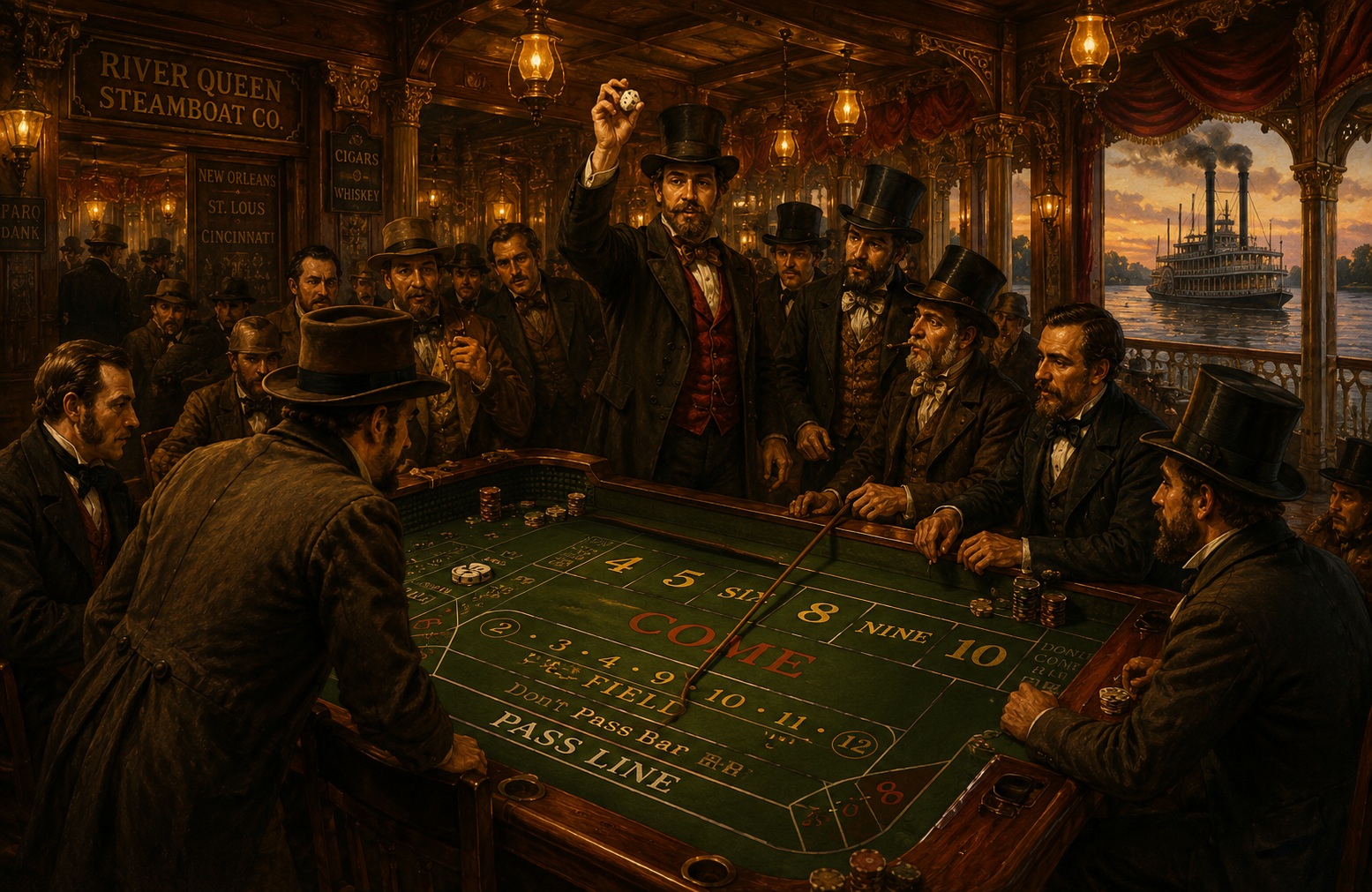
As gambling moved along the Mississippi, craps traveled with workers, soldiers, merchants, and professional gamblers. Riverboats created a romantic but rough environment for games of chance. They also created opportunities for cheating. Loaded dice, unfair rules, and one-sided betting arrangements were common enough that players looked for versions of the game that felt more balanced.
This pressure mattered. Games that survive in casinos usually need a structure that lets the house earn a profit while still feeling fair to players. Craps was moving toward that balance, but it needed one more important rules change.

John H. Winn: The Father of Modern Craps
John H. Winn is often credited with shaping modern casino craps by adding the Don't Pass option and helping standardize the layout. The ability to bet with or against the shooter made the game more balanced and reduced the advantage of dice mechanics or unfair street-bank arrangements. It also gave the casino a cleaner way to book action on both sides.
Winn's changes helped craps move from an informal dice game into a table game that could be supervised, staffed, and offered consistently. The modern layout, with its Pass Line, Don't Pass, Come, Don't Come, place numbers, Field, and proposition center, reflects that long process of standardization.
Standardization also made the game easier to teach. Once casinos could print the same betting areas on the felt and train crews to handle them the same way, players could move from one table to another without relearning the whole game. That consistency is one reason craps became a durable casino staple.
Craps in Las Vegas
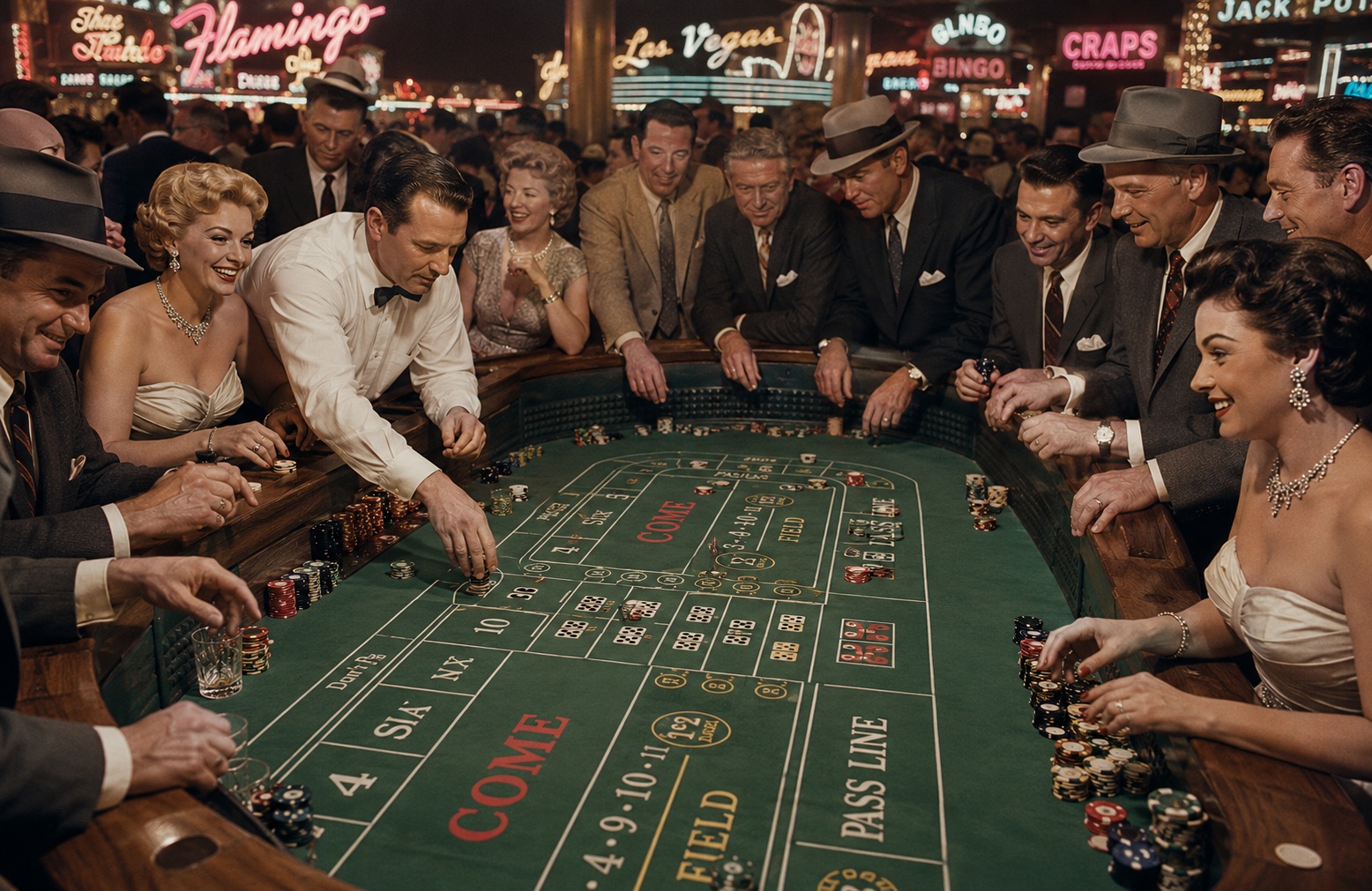
Las Vegas turned craps into spectacle. The long green tables, stacks of chips, practiced dealers, and crowded rails became part of the casino soundscape. During and after World War II, American servicemen helped spread craps because many had played dice in barracks and camps. When they visited Nevada casinos, the game already felt familiar.
Craps also fit the Las Vegas mythos: fast, communal, and theatrical. A hot shooter could draw a crowd. Dealers called results in a language that sounded like music to experienced players and mystery to beginners. The game became a fixture in films, casino stories, and gambling culture.
Craps in Popular Culture
Craps appears wherever writers and filmmakers want a scene to feel risky, social, and alive. It shows up in stories about New York gamblers, Las Vegas entertainers, soldiers, and casino professionals. The image of players packed around a table, cheering for a shooter, remains one of gambling's strongest visual symbols.
Online Craps: The Digital Era
Online casinos changed the experience again. Random-number-generator craps made the game available on desktop and mobile devices, while live dealer technology brought streamed table games closer to the casino floor. Online craps is quieter and more private than a casino table, which can help beginners learn without pressure. The online craps guide explains how to compare sites, bonuses, and game formats.
The Future of Craps
The next stage may include richer live dealer studios, mobile-first layouts, virtual reality casinos, and hybrid social tables. The technology will change, but the central drama will stay the same: two dice, one shooter, and a table waiting to see whether the point or the seven arrives first.
Craps has survived because it adapts without losing its core identity. Street players could play with little more than dice and cash. Riverboats gave the game movement and myth. Casinos added structure, dealers, standard layouts, and reliable payouts. Online casinos made the game available to players who may never stand at a packed rail. Each era changed the setting, but not the suspense of the throw.
That continuity is why learning the modern rules also connects you to a much older gaming tradition. The words may sound strange and the layout may look dense, but the emotional pattern is ancient: risk, release, result, and another chance to roll.