

How to Play Craps
Craps looks complicated because the felt is covered with boxes, numbers, and table slang. Underneath that busy layout is a simple repeating pattern. A shooter rolls two dice. The first roll of a hand is the come-out roll. Depending on the bet, that roll can win immediately, lose immediately, push, or establish a point. After a point exists, the shooter keeps rolling until the point appears again or a seven ends the hand.
That two-phase structure is the heart of craps. If you understand the come-out roll and the point phase, every other wager becomes easier to place. The betting guide explains the full menu, the strategy guide shows which bets are strongest, and the glossary translates the table language you will hear from dealers and players.
One helpful way to learn is to ignore most of the center layout at first. The center bets are exciting, but they are not necessary to understand a basic round. Watch the puck, listen for the dealer's call, and track only the Pass Line result. When you can explain why a 7 is good before the point but bad after the point, you have crossed the main beginner threshold.
The Table and Equipment
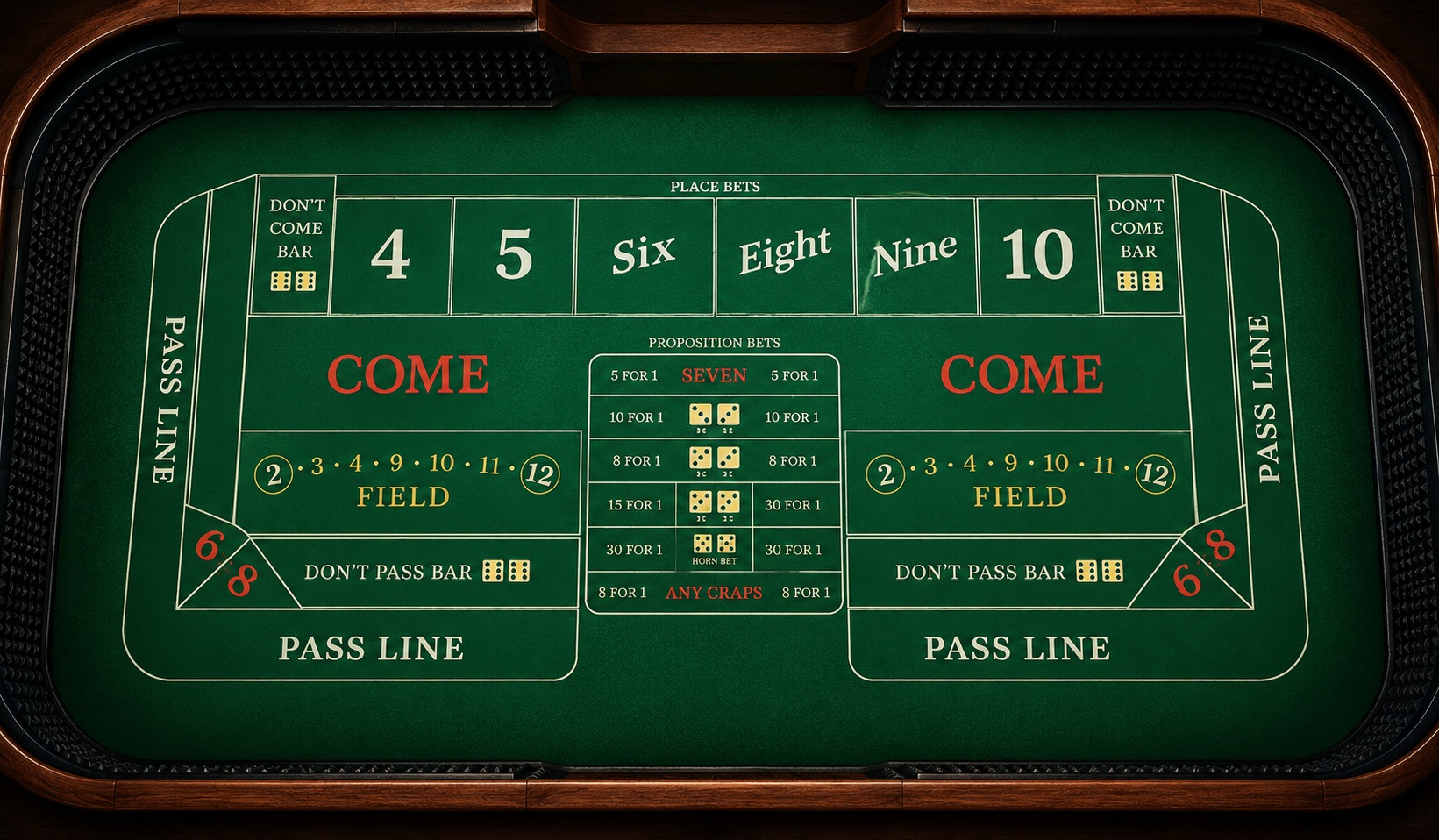
A casino craps table is staffed by a small crew. The stickman stands across from the boxman and controls the dice with a long stick, announces results, and manages the center proposition bets. Two base dealers stand on opposite sides, place chips, pay winners, collect losers, and answer player questions. The boxman watches the bank, supervises the dealers, and tracks table action. Players stand around the rail and keep chips in the rack in front of them.
The table uses two dice, a puck marked ON and OFF, and a felt layout divided into self-service areas and dealer-controlled areas. You may usually place chips yourself on the Pass Line, Don't Pass, Come, Don't Come, and Field. For place bets, odds, hardways, and proposition bets, tell the dealer what you want and let the crew position the chips correctly.
Most tables also have minimum and maximum bet signs. The minimum applies to many flat bets, but odds and some proposition bets can have their own rules. If you are unsure, ask the dealer between rolls. Good dealers would rather answer a quick question than fix a late or misplaced bet after the dice are already moving.
The Shooter
The shooter is the player currently rolling the dice. The dice rotate clockwise after a seven-out or after a player declines to shoot. In most casinos, the shooter must have a wager on either the Pass Line or Don't Pass before rolling. The shooter chooses two dice from the stickman's offered set, keeps them over the table, and throws them so they hit the far wall.
Phase 1: The Come-Out Roll
The come-out roll begins a new hand. If the shooter rolls 7 or 11, Pass Line bets win immediately and Don't Pass bets lose. These winning numbers are called naturals. If the shooter rolls 2, 3, or 12, Pass Line bets lose immediately; these are the craps numbers. On the Don't Pass, 2 or 3 usually wins and 12 is usually a push, meaning the bet neither wins nor loses. Some tables bar 2 instead of 12, so always read the felt.
If the come-out roll is 4, 5, 6, 8, 9, or 10, that number becomes the point. The dealer turns the puck to ON and places it on the point number. The game now enters the second phase. Pass Line players want the shooter to repeat the point before rolling a 7. Don't Pass players want the 7 to come first.
Come-out rolls can happen several times in a row if the shooter keeps rolling naturals or craps numbers. This is normal. The hand does not enter the point phase until one of the six box numbers is established. That is why the puck remains OFF until the dealer marks the point.
Phase 2: The Point Phase
Once a point exists, the shooter may roll many times. Neutral numbers do not settle the Pass Line bet, but they can resolve other bets. For example, a Field bet resolves on the very next roll, and a Come bet can travel to its own point. The main Pass Line question remains: point or seven?
If the shooter repeats the point, Pass Line bets win and Don't Pass bets lose. The puck turns OFF, and the same shooter begins a new come-out roll. If the shooter rolls a 7 first, the table calls seven-out. Pass Line bets lose, Don't Pass bets win, the dice move to the next shooter, and the cycle begins again.
Many additional bets can be working during this phase. A Place 6 can win while the Pass Line point is 9. A Come bet can travel to 5 while the original point remains 8. This is why experienced players may have chips in several positions at once, but every wager still has a defined win condition and loss condition.
Step-by-Step Example Round
Puck and On/Off Explained

The puck tells everyone whether a point exists. OFF means the next roll is a come-out roll. ON means the table is in the point phase, and the puck sits on the active point number. Some bets also depend on whether the puck is ON or OFF, so check with the dealer before assuming a wager is working.
Common Beginner Mistakes
- Betting the center of the table before understanding the house edge.
- Forgetting to take odds after a point is established.
- Putting chips in the dealer's hand instead of placing cash or chips on the felt.
- Throwing the dice too softly or failing to hit the back wall.
- Trying too many systems before mastering one simple Pass Line plan.
Ready to Try It Online?
Practice mode and low-stakes online tables can help you learn the flow before you stand at a crowded casino table.
Play Online Now